The Limits of Thought: Discussions by David Bohm
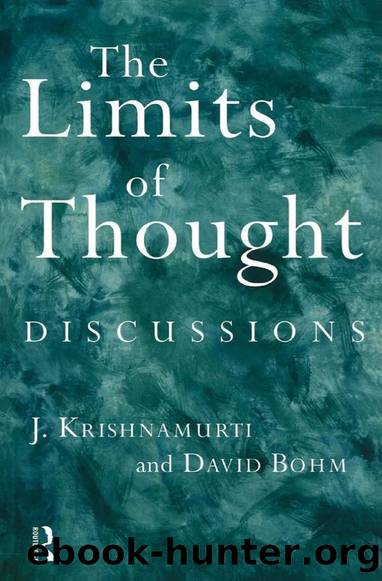
Author:David Bohm [Bohm, David]
Language: eng
Format: epub
ISBN: 9781134650262
Google: f6GEAgAAQBAJ
Amazon: 1134650264
Barnesnoble: 1134650264
Goodreads: 17496223
Publisher: Taylor and Francis
Published: 2011-08-01T05:00:00+00:00
4 Thought and perception
KRISHNAMURTI: Why has mankind given such tremendous importance to thought?
DAVID BOHM: You have pointed out that thought gives security in many senses, not only in the sense of psychological security, but also material security.
KRISHNAMURTI: Yes, thought in itself is not secure.
DAVID BOHM: Thought cannot be secure, itâs a mere reflection.
KRISHNAMURTI: Yes, therefore it cannot be secure in itself and seeks security outside.
DAVID BOHM: But why does it seek security?
KRISHNAMURTI: Because thought is constantly changing, constantly moving.
DAVID BOHM: But that doesnât explain why itâs not satisfied to just be that.
KRISHNAMURTI: Because it sees its own perishable nature.
DAVID BOHM: Why should it want to be imperishable?
KRISHNAMURTI: Because that which is imperishable is its security.
DAVID BOHM: If thought were content to say, âIâm insecure, Iâm impermanentâ, then it would be like nature, it would just say, âIâm here today and tomorrow Iâm different.â
KRISHNAMURTI: Of course. But I am not satisfied with that. Is it because of attachment?
DAVID BOHM: But what is attachment? Why should thought attach itself to anything? Why shouldnât it say, âIâm just thought, Iâm just a reflectionâ?
KRISHNAMURTI: But youâre giving to thought considerable intelligence. If it says, âIâm just like nature, I just come and go in constant movementâ¦â
DAVID BOHM: Now are you saying that thought is mechanical, thatâs why itâs doing this. Then we have to see why a mechanism should necessarily seek security. A machine doesnât seek anything in particular; we can set up a machine and it just goes.
KRISHNAMURTI: Of course. As long as there is energy, itâll go on working.
DAVID BOHM: If it breaks down, thatâs the end of it.
KRISHNAMURTI: But does thought realize that it is mechanical?
DAVID BOHM: No, but thought made a mistake, there is something incorrect in its content; which is, thought does not know itâs mechanical. But does that mean that thought thinks it is not mechanical?
KRISHNAMURTI: Sir, a mechanical thing doesnât get hurt.
DAVID BOHM: No, it just functions.
KRISHNAMURTI: Whereas thought gets hurt.
DAVID BOHM: And thought has pleasure.
KRISHNAMURTI: Yes, pleasure, pain, and all the rest of it. Letâs stick to one thing. It gets hurt. Why does it get hurt? Because of the image and so on. It has created the image, and in the thing that it has created it is seeking security, isnât it?
DAVID BOHM: Yes, it is not clear why it ever began to seek that kind of security. If it began as a mechanism, there was noâ¦
KRISHNAMURTI: This is rather interesting, isnât it? Why does thought not realize it is mechanical? Why does it suppose that it is something different from a machine?
DAVID BOHM: Yes, it may in some sense suppose it has intelligence and feeling and that itâs a living thing, rather than mechanical.
KRISHNAMURTI: I think thatâs the root of it, isnât it? It thinks itâs living. And therefore it attributes to itself the quality of non-mechanical existence. Thought is clever, giving itself qualities which basically it does not have. Why does it do it?
DAVID BOHM: You were saying that thought somehow can realize it is mechanical, which would imply that it had some intelligence.
Download
This site does not store any files on its server. We only index and link to content provided by other sites. Please contact the content providers to delete copyright contents if any and email us, we'll remove relevant links or contents immediately.
| Anthropology | Archaeology |
| Philosophy | Politics & Government |
| Social Sciences | Sociology |
| Women's Studies |
The remains of the day by Kazuo Ishiguro(8999)
Tools of Titans by Timothy Ferriss(8396)
Giovanni's Room by James Baldwin(7346)
The Black Swan by Nassim Nicholas Taleb(7129)
Inner Engineering: A Yogi's Guide to Joy by Sadhguru(6796)
The Way of Zen by Alan W. Watts(6614)
The Power of Now: A Guide to Spiritual Enlightenment by Eckhart Tolle(5781)
Asking the Right Questions: A Guide to Critical Thinking by M. Neil Browne & Stuart M. Keeley(5775)
The Six Wives Of Henry VIII (WOMEN IN HISTORY) by Fraser Antonia(5515)
Astrophysics for People in a Hurry by Neil DeGrasse Tyson(5190)
Housekeeping by Marilynne Robinson(4447)
12 Rules for Life by Jordan B. Peterson(4304)
Ikigai by Héctor García & Francesc Miralles(4274)
Double Down (Diary of a Wimpy Kid Book 11) by Jeff Kinney(4272)
The Ethical Slut by Janet W. Hardy(4253)
Skin in the Game by Nassim Nicholas Taleb(4248)
The Art of Happiness by The Dalai Lama(4130)
Skin in the Game: Hidden Asymmetries in Daily Life by Nassim Nicholas Taleb(4007)
Walking by Henry David Thoreau(3962)
